Europe's Festival Group Travel Guide 2026
Europe recorded 793 million international tourists in 2025, a 4% increase from 2024, and most of that growth is coming from group trips. Only 11% of Europeans planned a solo trip in 2024 - the rest travel with someone. The European group travel market reached $38.7 billion that same year, and it has continued to grow at around 6% annually. Yet most people still plan group trips the same way they plan solo ones: last-minute and with no fixed route. Festivals are where these statistics change: 77% of festival-goers attend with others, 40% in groups of four or more, and 44% of tickets are bought three or more months in advance. For a group heading to two or three events in one trip, transportation decides whether the trip will be memorable because of the enjoyment or the struggle.
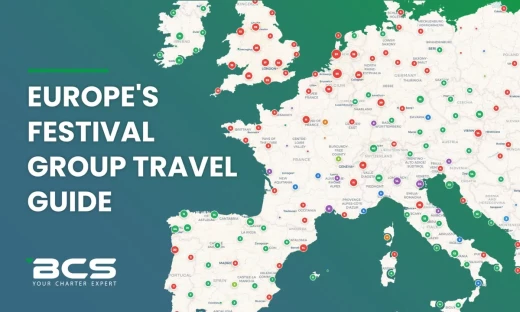
At BCS Bus, we researched publicly available data on festivals across 40+ European countries, covering 8 categories: music, film, carnivals, fashion, handicrafts, food, beer & wine, and Christmas markets. The Interactive European Festival Map 2026 that accompanies this research covers 2,800+ events, searchable and filterable by country, month, and category, with map or calendar view.
Key Insights From Our Data
-
1
The UK leads total festival counts in our data (331). Though the gap is partly explained by better data coverage for English-language sources.
-
2
Spain hosts 219 food festivals across the 14 countries researched - more than double the UK's 102.
-
3
The Benelux region fits 6-8 major international festivals within 200 km - the strongest case for multi-festival group trips in Europe.
-
4
Germany leads Christmas Markets (25), most of them within a 420 km coach corridor.
-
5
Estonia hosts 43 film festivals for 1.37 million people: 31.4 per million, the highest film festival density in Europe.
Music Festivals
The UK has the largest number of festivals in Europe (174). While the difference is partly related to how well larger festivals are indexed by databases in English, there is a strong cultural basis for the difference: Music tourism in the UK generated £10bn in revenue in 2024, with an increase of 26% compared to 2023. These statistics show how well the festival industry is developed in the United Kingdom.
Per capita, the Netherlands makes a stronger argument: 3.5 festivals per million residents vs. the UK's 2.6. Amsterdam Dance Event alone draws 600,000+ attendees across 150 countries in October. ADE, Dekmantel, and Awakenings cover the EDM calendar from April through October. Not only is the Netherlands more geographically concentrated, but a group planning a multi-festival itinerary around electronic music will find most events reachable within 200 km of Amsterdam, making coach travel between them a straightforward logistical choice.
| # | Country | Festivals | Per Million | Group Travel Note |
|---|---|---|---|---|
| 1 | United Kingdom | 174 | 2.6 | Reading, Leeds, Download - most within 300 km |
| 2 | Netherlands | 62 | 3.5 | ADE, Dekmantel, Awakenings - best EDM trip in Europe |
| 3 | Germany | 60 | 0.7 | Berlin, Munich, Hamburg - good multi-stop route |
| 4 | France | 43 | 0.6 | Paris, Lyon, Bordeaux - easy to chain in a single road trip |
| 5 | Spain | 40 | 0.8 | Primavera, Mad Cool, FIB - Iberian arc, 700 km end-to-end |
Fashion Events
France leads with a total of 89 fashion events, followed closely by Italy's 63. Paris sets the global fashion trends with the rest of the country. Fashion events happen in France all year round across Paris, Lyon, and Bordeaux. Such a variety of events allows you to take a trip with your group in any season you choose.
At 1.07 per million people, Italy's 63 events are the next highest number of fashion shows per capita. Milan and Florence continue to be the most popular cities in Europe for fashion-related group travel.
Belgium surprises with 26 fashion events, and shows the second-highest per capita rate of 2.22 per million, beating France (1.30 per million). Belgium is a natural addition to any Benelux itinerary focused on trade shows or corporate events. Brussels and Ghent provide a unique opportunity to experience the fashion side of the country.
| # | Country | Festivals | Per Million | Group Travel Note |
|---|---|---|---|---|
| 1 | France | 89 | 1.30 | Paris, Lyon, Bordeaux - year-round calendar |
| 2 | Italy | 63 | 1.07 | Milan and Florence host the biggest events |
| 3 | Germany | 38 | 0.45 | Trade-fair oriented - suits corporate group trips |
| 4 | Spain | 28 | 0.58 | Barcelona leads, spring concentration |
| 5 | Belgium | 26 | 2.22 | 2nd per capita - Brussels and Ghent |
Food Events
Note: Food festival data was researched for 14 countries. Countries not listed were not researched; not empty - direct comparisons across the full European market are not possible.
Spain's 219 food events represent the highest number out of all European countries. Both the Galician and Valencian regions alone host the majority of food events happening in Spain. For instance, La Tomatina in Buñol is the single most covered group event in the world. Participants throw 100+ tons of tomatoes each year in late August during the event.
Spain and the Netherlands demonstrate the same per-capita rate of 4.6 per million. The Netherlands, in fact, offers 82 food festivals. For groups based in Northern Europe, the Netherlands provides a similar festival density as Spain. However, a long travel distance to Galicia (approximately 1,500 kilometers) makes the Netherlands a better option than traveling to Spain due to its compact size when a group is traveling with limited travel days.
| # | Country | Festivals (14 researched) | Per Million | Group Travel Note |
|---|---|---|---|---|
| 1 | Spain | 219 | 4.6 | Galicia and Valencia - La Tomatina and more |
| 2 | United Kingdom | 102 | 1.5 | Wide regional spread, May–September |
| 3 | Italy | 91 | 1.5 | Alba, Tuscany, Sicily - premium culinary trips |
| 4 | Germany | 89 | 1.1 | Multi-city spread - good for coach itineraries |
| 5 | Netherlands | 82 | 4.6 | Ties Spain per capita - best for Northern Europe groups |
Film Festivals
The United Kingdom holds first place with 120 film festivals, followed by Italy (110). However, the difference between the two countries' film festivals per capita is the lowest in the study: Italy has 1.9 per million compared to the UK's 1.8. The most renowned film events usually happen in Venice, Turin, Giffoni, and Salerno.
Poland (54 film festivals, 1.5 per million density) unexpectedly appears on the list. Both Krakow and Warsaw host international film festivals annually, inviting group travelers to explore not only the latest movie trends but also other fascinating events and destinations.
Estonia demonstrates the highest movie festival density in Europe, with a population of 1.37 residents (31.4 per million). The country hosts a total of 43 movie events annually. Tallinn's compact old town and city centre allow a group to reach film event venues on foot. A group looking to organize a film tourism itinerary will be unable to find a similar density of film festivals anywhere else in Europe compared to Estonia.
| # | Country | Festivals | Per Million | Group Travel Note |
|---|---|---|---|---|
| 1 | United Kingdom | 120 | 1.8 | London anchors; regional spread across the country |
| 2 | Italy | 110 | 1.9 | Venice leads a national network - the highest per capita in the top 5 |
| 3 | France | 82 | 1.2 | Cannes centrepiece; Deauville and Lyon add regional options |
| 4 | Spain | 60 | 1.3 | San Sebastián, Malaga, Sitges - strong October group trips |
| 5 | Poland | 54 | 1.5 | Kraków and Warsaw are serious centers |
| - | Estonia | 43 | 31.4 | Highest per capita in Europe by a large margin |
Beer & Wine Festivals
France (35), Italy (34), and Germany (32) have the most accessible data on their beer & wine events, and all three offer well-established coach routes between their major wine regions. Portugal stands out on per-capita terms at 1.35 per million - the highest in the table. Unfortunately, the Douro and Alentejo regions are still largely skipped by most group travel itineraries in Europe. A coach itinerary connecting Porto, the Douro Valley, and Évora covers most of what Portugal's wine calendar offers, at a price point well below equivalent itineraries in Burgundy or Tuscany.
For beer-focused trips, Germany's Bavaria connects Nuremberg, Regensburg, and Augsburg within a 150 km radius. Oktoberfest bans parking in the immediate surroundings, which makes a group coach the practical option for this event (and of course, much more preferred than a car) - a constraint that applies to most large outdoor festival sites across the continent.
| # | Country | Festivals | Per Million | Group Travel Note |
|---|---|---|---|---|
| 1 | France | 35 | 0.51 | Burgundy to Languedoc - multi-region coach routes |
| 2 | Italy | 34 | 0.58 | Tuscany, Piedmont, Sicily - pairs well with food itineraries |
| 3 | Germany | 32 | 0.38 | The Bavaria circuit, 150 km radius, covers multiple events |
| 4 | Spain | 21 | 0.44 | Rioja and Catalonia - autumn concentration |
| 5 | Portugal | 14 | 1.35 | Highest per capita; Douro and Alentejo are undervisited |
Christmas Markets
Germany has some of the oldest Christmas markets in Europe and, probably, the easiest to chain into a group itinerary. The Nürnberger Christkindlesmarkt has been running since the 1600s and draws 2 million visitors annually; the Dresdner Striezelmarkt, founded in 1434, is the oldest in Germany; and Stuttgart's market receives 3.5 to 4 million visitors across 300 stalls. All three run simultaneously from late November through December 23–24, and Cologne adds seven markets within walking distance of each other in the city centre.
Austria leads on per-capita terms at 0.66 per million, and Vienna is located 240 km from Munich - a natural extension of any German Christmas loop that adds one of the most atmospheric city markets in Europe without significantly extending the route. A journey from Cologne to Vienna via Nuremberg and Dresden covers 420 km and connects four of the continent's most-visited winter markets in a single group trip.
| # | Country | Markets | Per Million | Group Travel Note |
|---|---|---|---|---|
| 1 | Germany | 25 | 0.30 | Cologne, Nuremberg, Dresden - all within a 420 km route |
| 2 | United Kingdom | 11 | 0.16 | London, Edinburgh, Manchester |
| 3 | France | 7 | 0.10 | Strasbourg leads; Alsace is the most concentrated region |
| 4 | Austria | 6 | 0.66 | Per capita leader; Vienna extends the German corridor east |
| 5 | Switzerland | 4 | 0.45 | Basel and Zurich |
Festival Clusters and Group Transport
Europe's biggest festivals are conveniently located in clusters, and six routes may account for the majority of group transport demand across the continent.
| Cluster | Key Events | Coach Distance |
|---|---|---|
| Benelux | Tomorrowland, Rock Werchter, Dekmantel, Lowlands | 200 km - Boom to Amsterdam ~1.5 hrs |
| Central Europe | Sziget, EXIT, UNTOLD, Electric Castle | 400 km - Budapest to Vienna ~2.5 hrs |
| Iberian Circuit | Primavera Sound, Sónar, NOS Alive, Mad Cool | 760 km - Lisbon to Barcelona ~7 hrs |
| Germany–Austria Xmas | Cologne, Nuremberg, Dresden, and Vienna markets | 420 km - Cologne to Vienna ~4 hrs |
| Adriatic Croatia | Ultra Europe, INmusic, Hideout, Sonus | 350 km - Zagreb to Split ~4 hrs |
| UK Summer | Reading, Leeds, Creamfields, Download | 300 km - London to Leeds ~3 hrs |
Benelux is perhaps the best example in this case. Tomorrowland, Rock Werchter, and Lowlands take place over a six-week period from late July through early August, while Boom (Belgium) and Amsterdam (Netherlands) are just 130 kilometers apart from each other. A simple overnight stop and a coach can help a group to cover three events altogether - no airport needed, no baggage check, no missed connections.
Almost 40% of attendees travel by coach to Glastonbury festival from 90+ departure points across the UK. The number isn't a coincidence. Most festivals take place outside city centres. Parking is either banned or overpriced for those who travel by car. A dedicated coach is the option that handles the return journey for the whole group at once. Moreover, coach travel produces 5–6x fewer CO₂ emissions per passenger-km than cars.
Methodology
Festival data was collected from Music Festival Wizard, FestAgent, Eventseye, CarnivalVibez, and regional tourism and government databases. Music festival data covers 40+ countries. Food festival data was researched for 14 countries: Spain, the UK, Italy, Germany, the Netherlands, Switzerland, Croatia, the Czech Republic, Ireland, Austria, Belgium, France, Portugal, and Greece. Per-capita figures use 2025 population estimates from Eurostat and national statistical offices. UK totals combine England, Scotland, and Wales. Festival counts cover verified events with confirmed 2026 dates at the time of collection.