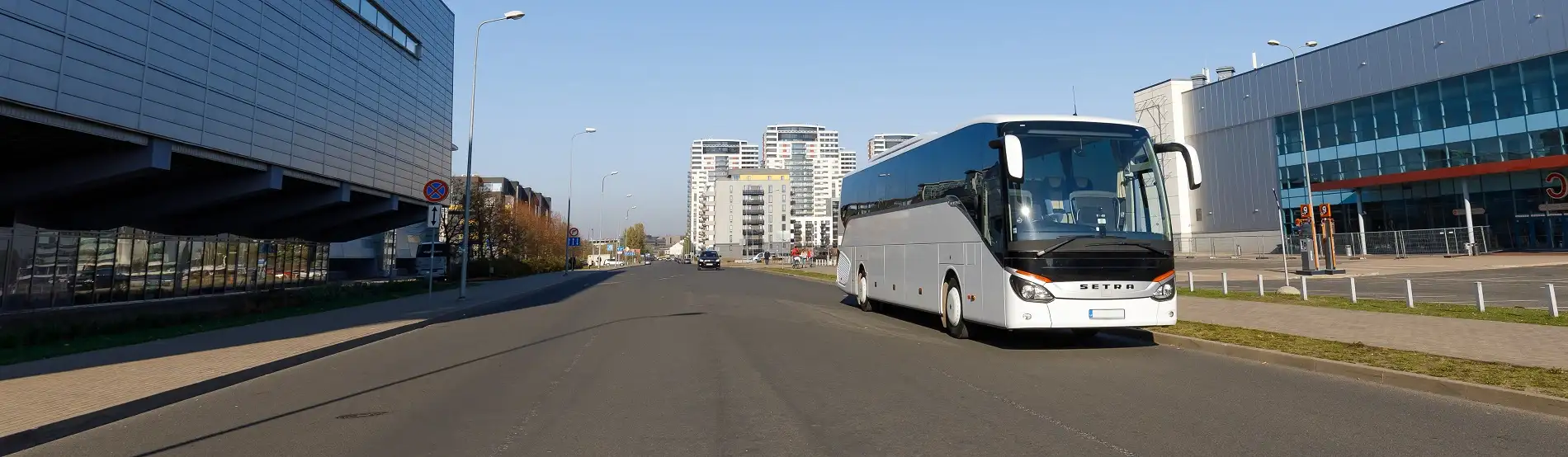
Corporate Transportation Solutions for Conferences, Business Travel, and Executive Mobility
In corporate travel planning, transportation to and from an event is often underestimated until something goes wrong. Missed arrivals, frustrated guests, and hurried decisions can quickly set an adverse tone, sometimes before anyone has even unpacked their bags.
BCS Bus approaches corporate travel logistics as a connected system, not a background task. Whether it is conferences, executive travel, or multi-day programs, the common thread is the movement of guests across multiple locations with little margin for error.

 Excellent
Book Your Service
Get a quote within 30 minutes
- On-Time Guarantee
- Fleet Under 5 Years Old
- Local Expert Drivers
- 4.8/5 Rating
- Tree Planted Per Trip
When schedules shift, flights are delayed, or venues change access requirements, transportation is often the first pressure point. In these situations, the role of transportation is simple: to reduce uncertainty. Planning for those realities early allows events to continue running smoothly, even when conditions are less than ideal.
Instead of offering fixed packages, BCS Bus works with clients to design transportation that reflects how events actually run, not how they look in a proposal. This applies across the full range of program types, from Meetings, Incentives, Conferences, and Exhibitions (MICE) events and corporate roadshows to executive programs requiring dedicated coach hire across Europe.
Why Corporate Clients Choose BCS Bus for Transportation
Corporate clients choose BCS Bus for three reasons: one named contact for the whole programme, a vetted carrier in each city, and a 24/7 operations desk that handles vehicle problems while the programme runs.

For corporate travel planners, HR teams, event organizers, and Destination Management Companies (DMCs), transportation is not just about availability. It is about trust. For corporate travel managers, duty of care is not abstract. It is a direct responsibility covering every movement in the program, from arrival to final transfer.
BCS Bus has been operating in European group transportation for 14+ years, supporting complex travel needs in over 20 countries and transporting tens of thousands of passengers each year. During that time, the company has worked with more than 1,400 corporate clients and has been recognized for service quality and customer satisfaction with the Tripadvisor Travelers’ Choice Award for 2026.
- 14+Years of experience (since 2012)
- 20+European countries covered
- 1,400+Corporate clients served
- 2026Tripadvisor Travelers' Choice, 500+ verified reviews
When schedules are tight and expectations are high, the choice of transportation partner becomes critical. BCS Bus combines structured planning with hands-on coordination, ensuring transportation aligns with venues, schedules, and event programs. The team's role is to anticipate challenges early, design practical solutions, and remain flexible as plans evolve.
Every corporate program offered by BCS Bus is executed by a transportation manager who stays available for the client from the moment they book the service to the final transfer. That person will be the focal point for group leaders to contact. Besides that, the 24/7 operations desk is ready to handle vehicle issues with the necessary agility. Whenever a situation requires escalation, BCS Bus takes charge without requiring any action from the client.
To understand how this approach works in practice, it helps to look at a typical corporate scenario. The following example reflects the kinds of transportation challenges conference and event organizers regularly face and how BCS Bus approaches them from the outset.
A Real-World Example: Conference Evening Transportation
A common challenge in corporate event transportation involves evening events during international conferences. Attendees need to travel from the main conference venue to a reception or dinner location over several hours, with guests arriving and leaving at different times. In many cases, final venue details are confirmed close to the event, but expectations remain the same: transportation should run smoothly and continuously throughout the evening.
In these situations, the main challenge is rarely the number of vehicles alone. More often, it involves designing a shuttle system that allows steady movement between locations, accommodates changing demand, and remains predictable from a cost perspective.
Instead of treating this as a single transfer, BCS Bus plans around how guests actually move during the event. Preparation typically takes into account anticipated group size and peak movement periods, how continuous shuttle loops compare to fixed departure times, and driver scheduling across the evening. It also needs to factor in venue distance, local traffic conditions, and the ability to adjust operations on site if demand changes.
By addressing these factors early, organizers gain clarity around both logistics and budget, even when certain details, such as the final venue, are still being confirmed.
This is also where many transportation plans fail. Too much emphasis is placed on ideal schedules, and not enough on how events actually behave once people start moving.
BCS Bus focuses on preparation that holds up under real operating conditions. The work is shaped by timing constraints, venue access rules, and the points where delays tend to appear. Some of this is predictable. Some of it is not.
Throughout the process, clients work with coordinators who understand the full itinerary and remain available both before and during the event. The aim is not to eliminate change, but to manage it calmly and predictably. Not every event needs a complex transportation plan, but most benefit from someone questioning the assumptions early.
That process of questioning assumptions is where the logistics work begins.
How We Work
BCS Bus has perfected its booking process over the years in order to make it easy and frictionless. With a program manager working in the field to coordinate the whole service and an operations desk ready to gather any additional resource that proves necessary, you can rest assured that your group’s experience will be smooth and pleasant. This is our process:

Bring your service requirements: At the first contact, feel free to inform our team of the service dates, group size, venues to visit, and any specific schedule your travel group needs to fulfill.
BCS Bus manages the resources: Our transportation specialist analyzes your request and selects the best carrier and vehicle from our network considering your itinerary and local access rules.
Our team coordinates the trip: The specialist maps the timings against your event schedule and runs route simulations to identify where delays are likely before the programme starts.
The program manager steps in: Once you conclude your request, BCS Bus will assign a program manager who will supervise everything about the corporate trip until the very last transfer.
Live supervision 24/7: Besides the field work, our operations desk will be supervising your trip 24/7. They will be able to anticipate any issues before they become a nuisance to your group.
Logistics, Planning and Schedule Flexibility
Corporate event logistics require structured preparation well before the program begins. BCS Bus starts each program with a requirement mapping process, building a transport blueprint against the event schedule, and running route simulations to identify potential delays before they occur. A dedicated program manager serves as the single point of contact throughout, providing real-time support as the program unfolds.
Bottleneck prevention is built into the preparation process from the start, whether that means staggering departure times, adjusting vehicle allocation across morning peaks, or preparing contingency options for schedule changes. 14+ years of experience has taught us that live events rarely run exactly as planned. The priority is how quickly and calmly adjustments can be made when situations change.
Questions about Schedule Changes and Flexibility
Answers by Maxim K., COO at BCS Bus. Based on real operational experience. Reviewed October 2026.
What happens if event timings change after transportation has already been scheduled?
It depends on how far in advance the change is requested. For large-scale events, vehicle schedules are generally planned well ahead of the date, so availability becomes limited the closer you get. If the event is two to three weeks out, changes can be impossible to accommodate.
The booking type also has an impact. A coach booked for a one-way morning transfer would likely already be scheduled to serve another client afterward, which makes adjustments difficult. Hourly bookings tend to offer more flexibility.
As a general rule, the earlier you let us know, the better the chance we can make it work.
What happens when last-minute schedule changes come in on the day of an event?
Even with early planning, last-minute changes do occur. When a change comes in, our first step is to check whether the existing vehicle can be extended or reassigned. If the original provider cannot accommodate the change, we ask whether they can deploy a different vehicle. If that is not possible, we will arrange a new booking, but it will typically come at an additional cost.
BCS Bus has an operations desk available 24/7, so the team is immediately notified in case a bus has a problem. In that case, we identify where the bus had to stop and start calling the nearest suppliers until we find another one available with a driver. That process might take longer in regions with a smaller selection available, but we send the new vehicle as soon as we confirm it. And the client, of course, receives the new driver’s contact information in advance.
Conference, Congress and MICE Event Transportation
BCS Bus supports the full range of MICE events, from single-day industry congresses to multi-day international conferences, incentive programs, and corporate exhibitions.
BCS Bus provides conference transportation across Europe, planning around flow and timing rather than fixed departure schedules. The focus here is how people actually move throughout the day, including peak arrival periods, session changes, and evening events where movement is less predictable.
Coverage typically includes airport arrivals and departures, conference shuttle services between hotels and venues, and continuous movement between locations during receptions, dinners, or off-site activities. Vehicle requirements are scaled to match attendance levels, with the ability to adjust as numbers change or schedules evolve.
Preparation accounts for morning peaks when delegate arrivals concentrate around registration windows, and afternoon dispersal when session endings create simultaneous demand across multiple hotel and venue locations.
For trade shows and exhibitions, this includes early venue access for exhibitors ahead of opening at convention centers and expo halls, and late-evening breakdown schedules when doors close and staff need prompt transfers back to hotels.
Exhibition and Congress Venues We Serve
BCS Bus specializes in managing conference shuttle services at major venues such as Fiera Milano, Fira Barcelona, IFEMA Madrid, Messe Berlin, Koelnmesse, Messe Düsseldorf, Messe Frankfurt, Paris Expo Porte de Versailles, Paris Nord Villepinte, and RAI Amsterdam. Our carriers are experienced with traffic rules around those venues, so they are prepared to avoid typical situations that would cause delays.
- Fiera Milano
- Fira Barcelona
- IFEMA Madrid
- Messe Berlin
- Koelnmesse
- Messe Düsseldorf
- Messe Frankfurt
- Paris Expo Porte de Versailles
- Paris Nord Villepinte
- RAI Amsterdam
In Barcelona, for example, it is easy to mistake two exhibition halls because they are on the same street, only a few kilometers apart.
Whether an event is hosted at a single venue or spread across multiple locations, the priority remains keeping people moving comfortably while organizers retain control over timing and cost. This is usually the point where assumptions about schedules, group size, and coordination are tested.
Questions about Conference and Delegate Transportation
Answers by Maxim K., COO at BCS Bus. Based on real operational experience. Reviewed October 2026.
When does a continuous shuttle service work better than fixed departures?
Shuttle services work better when flexibility is required, for example, when the number of guests is yet to be confirmed. If registrations are still coming in close to the event date, a shuttle service is ideal because it will make multiple trips to accommodate arrivals as they come in.
Fixed departures tend to work better when the group size is confirmed, and a group leader is in place. In that situation, departures from set points at set times are easier to manage and more efficient overall.
How should logistics be handled for groups arriving on multiple flights?
When groups arrive on different flights, the most important thing is to build in extra time for baggage collection. Trying to synchronize a single departure too tightly across multiple arrivals rarely works in practice.
The simplest approach is to have one organizer collecting arrivals and bringing everyone to the vehicle together, avoiding the situation where early arrivals are left waiting on the bus.
For larger events, such as the international medical conference BCS Bus coordinated in Paris, individual arrivals from multiple international flights were managed using a mixed group of minibuses and coaches, with each pickup verified as passengers came through.
Is a dedicated coordinator necessary for large corporate events?
For events with 150 participants or more, a dedicated coordinator is essential. Without clear lines of responsibility, conflicting instructions will create confusion. We experienced this firsthand at an event in Munich where different agents were giving contradictory directions.
The solution is straightforward: whenever the event has 150-200 participants or more, it needs one coordinator from the transport side and one from the client side. With that structure in place, decisions are made quickly, and everyone is aligned.
Book Your Service
Get a quote within 30 minutes
- On-Time Guarantee
- Fleet Under 5 Years Old
- Local Expert Drivers
- 4.8/5 Rating
Corporate Transportation for Every Program Type
Conferences and congresses are covered above, but the same approach applies to corporate coach hire across other program types too.
Incentive travel is a good example. Groups attending off-site experiences or gala evenings expect the transport to reflect the quality of the program. That means thinking carefully about vehicle selection and timing, not just getting people from A to B. BCS Bus coordinates route timing, vehicle allocation, driver briefing, and service supervision. Vehicles range from executive minibuses for smaller VIP groups to full coaches for larger incentive travel groups throughout the continent.
Trade shows and exhibitions have their own rhythm. Exhibitors need to be at the venue before doors open, and when the day ends, staff need to get back to their hotels without delay. For multi-day events, BCS Bus builds shuttle schedules around badge access and opening hours so the transport runs consistently throughout.
Corporate roadshows are different again. The program moves through several cities, sometimes crossing borders, and the transport needs to keep pace. BCS Bus coordinates the multi-city ground logistics continent-wide and provides driver continuity from the first stop to the last.
Conferences and Congresses
BCS Bus can make delegate arrivals easy by planning hotel-to-venue shuttles. Our carriers are familiar with major venues, so driving to evening receptions will not be a problem even in a busy day.
Incentive Travel
Whether the group is scheduled to attend off-site experiences or gala evenings, our team will be able to match it with high-quality vehicles, all of them compliant with Euro 6 and equipped with convenience amenities.
Trade Fairs and Exhibitions
Our network of business partners can accommodate special requests which are common in this field, such as early exhibitor access before the event starts, multi-day shuttle schedules, and late-night transfers.
Corporate Roadshows
For multi-city legs, BCS Bus selects carriers with all the necessary experience. They can handle cross-border movement with a consistent standard from the first stop to the last; your group will have a smooth and efficient experience.
Questions about Group Size and Executive Transportation
Answers by Maxim K., COO at BCS Bus. Based on real operational experience. Reviewed October 2026.
What is the difference in how you plan transportation for a group of 200 conference attendees versus a single C-level executive with a tight schedule?
For a single executive, the best solution is a passenger car with a dedicated driver. Unlike a coach, a car is not subject to the same working hour restrictions, so the driver can remain available and adapt to any schedule changes as they arise.
For 200 people, the approach is quite different. Depending on the schedule and group size, either several coaches running fixed departures or a shuttle operation is advisable. Coach drivers have regulated working hours, which need to be factored in from the start.
With larger group events, BCS Bus often recommends a split approach: coaches for the main group and smaller vehicles for management or speakers. It is a bit more expensive, but it will give senior attendees the mobility and availability they typically require.
Book Your Service
Get a quote within 30 minutes
- On-Time Guarantee
- Fleet Under 5 Years Old
- Local Expert Drivers
- 4.8/5 Rating
European Coverage and Local Expertise
BCS Bus coordinates corporate programmes in 20+ European countries, combining central planning with a local carrier in each city. Moving groups across Europe, such as from Amsterdam and Paris to Barcelona and Geneva, introduces layers of complexity that are easy to underestimate.
Regulations, access rules, traffic patterns, and venue logistics vary widely between cities and countries. What works smoothly in one location may not translate at all in another, particularly when restricted zones, local event traffic management, or airport procedures are involved. Coordination needs to account for these differences early, not after vehicles are already in operation.
Across the Schengen Area, multi-country programs benefit from simplified border movement, but driver hours, route documentation, and local carrier regulations still require advance planning.
Many European city centers now operate Low-Emission Zones (LEZ) or Ultra-Low Emission Zones (ULEZ), restricting access to higher-emission vehicles. BCS Bus selects carriers whose vehicles meet Euro 6 emissions standards, which keeps programmes running through those zones without disruption.
How Local Execution Works in Each City
BCS Bus supports corporate travel across Europe by combining centralized preparation with local execution. Transportation is coordinated through a single point of contact, while on-the-ground delivery reflects local conditions, regulations, and operating realities in each destination.
Local drivers are selected for their familiarity with city-specific requirements, including restricted access zones, event traffic management, and airport procedures. Vehicle options are matched to group size and itinerary, whether the journey involves executive transfers, shuttle services, or multi-city programs.
The result is that corporate clients maintain consistent standards across destinations without losing the benefits of local knowledge, which helps in terms of venue recommendations, safety tips, and unique details about each location. Coordination remains structured, communication stays clear, and adjustments can be made quickly when conditions change.
This is where local experience tends to matter most.
Questions about Cross-Border Corporate Transportation
Answers by Maxim K., COO at BCS Bus. Based on real operational experience. Reviewed October 2026.
What additional planning is required when transportation spans multiple countries?
Mapping out the route will determine whether one driver can complete it within the limits set by EU driver working hours regulations (EC Regulation 561/2006), or if a second driver will be needed. For long non-stop journeys, a third driver may be required to rotate throughout the trip.
Night transfers also need to be taken into consideration. For example, if a group needs transport late in the evening and the driver has no working time remaining, BCS Bus will arrange local transport to complete that leg of the journey.
Route preparation matters just as much. The driver reviews the route in advance to account for toll roads and bridges because their traffic conditions might affect the trip’s estimated duration.
For trips involving ferry crossings, such as to Britain, Denmark, or Sweden, passenger details need to be confirmed early as spaces fill up quickly. Coaches travelling to Britain go by ferry rather than the Channel Tunnel, which carries mainly freight and passenger trains. In this case, our team recommends booking a month in advance. Keep in mind that ferries become more expensive from Friday to Monday.
Which European countries or cities create the most unexpected complications for corporate transportation and what are those complications specifically?
France can catch operators off guard with trailer regulations. If a luggage trailer is left on the street without the correct signage, the police can tow it without warning.
Road inspections are generally unpredictable across Europe, lasting anywhere from ten minutes to two hours. They typically cover driver rest and working times, required documents, insurance, and vehicle safety.
Switzerland applies Cabotage rules to protect domestic carriers, and border controls at entry and exit are common. Italy and Spain are increasingly complex, with city center permits required and specific time windows that must be arranged well in advance.
Germany has the most rigorous road police controls in Europe. Autobahns are free for coaches, but operators must pay a 19% tax after the trip based on kilometers driven, with all associated paperwork completed accurately.
Speaking of Germany, it is important that drivers record all trip details into the tachograph. If a rest pause was not registered, even for reasons such as the bus running out of battery overnight, road enforcement officers will consider it a case of irregular work hours and tow the vehicle to an impound lot. Inspection often takes a long time due to long lines, so the operations desk would need to send another vehicle to finish the trip.
Vehicles We Deploy
BCS Bus works with corporate bus charter carriers across Europe, ranging from executive cars to full-size motorcoaches, matched to the scale and nature of each program. For smaller groups and executive transfers, Mercedes-Benz Sprinter minibuses and Mercedes V-Class vehicles offer a discreet, comfortable option with capacity for six to sixteen passengers. For larger delegations, VIP minibuses and full-size motorcoaches accommodate groups of up to 55 passengers or more.
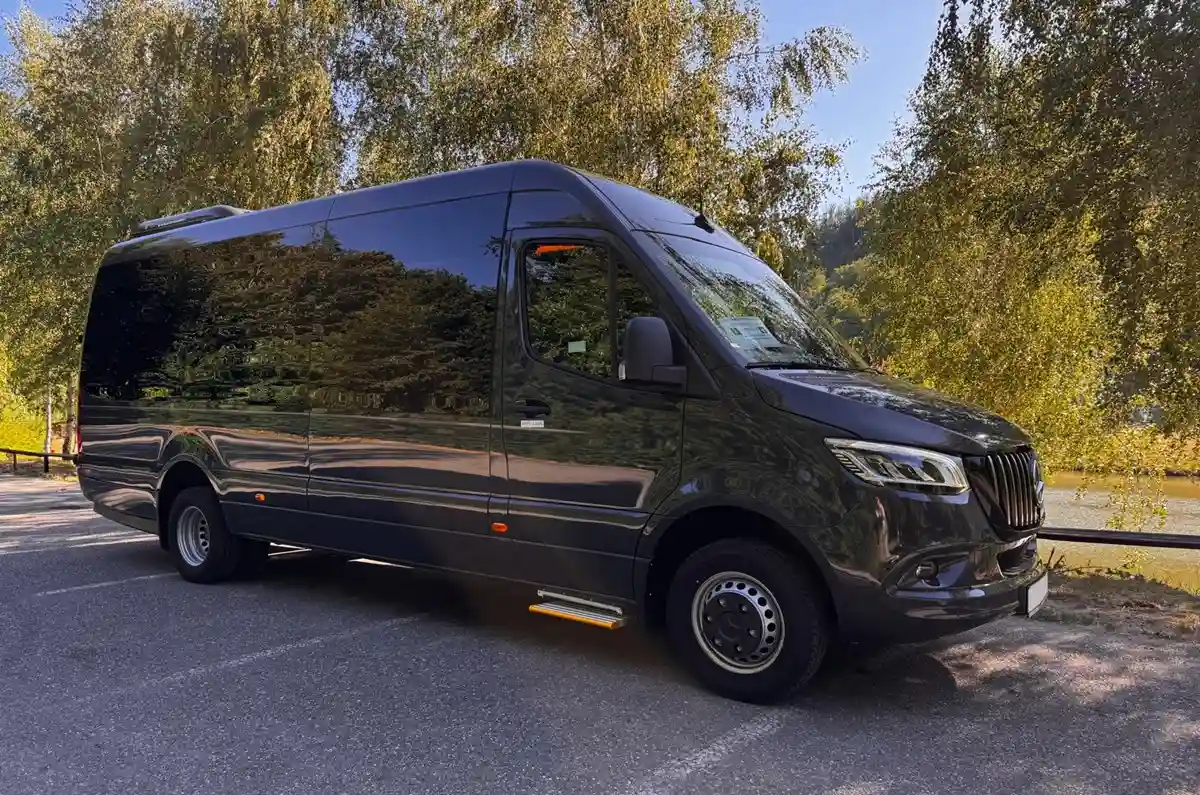
| Vehicle | Capacity | Typical use |
|---|---|---|
| Mercedes-Benz V-Class | Up to 7 passengers | Executive transfers, speakers, senior leadership |
| Mercedes-Benz Sprinter | 8 to 16 passengers | Small delegations, airport arrivals |
| VIP minibus | 16 to 30 passengers | Incentive groups, premium programs, roadshows |
| Full-size coach bus | Up to 55 passengers | Delegate groups, conference shuttles, trade fair transfers |
Premium vehicles are equipped with reclining seats, onboard Wi-Fi, USB and power outlets, PA systems, climate control, and generous luggage capacity. Most vehicles deployed by our corporate minibus hire are under five years old.
For a single event, BCS Bus can combine vehicle types within the same operation. Full-size coaches handle the main delegate group while executive vehicles or minibuses are assigned to speakers, VIPs, and senior leadership. The split keeps logistics efficient without compromising the experience for senior attendees.
BCS Bus selects its carriers for their experience, which is backed by valid operating licenses and certifications, and their Euro 6-compliant vehicles. Complying with those emissions standards ensures access to Low-Emission Zones and Ultra-Low Emission Zones across European cities without disruption to the program.
Sustainability and Environmental Responsibility
Sustainability is no longer a side issue in corporate travel, but it is most effective when built into everyday operational decisions, not treated as a separate initiative.
BCS Bus prioritizes carriers with Euro 6-compliant vehicles, while maintaining flexibility in vehicle selection and routing to meet the practical demands of complex itineraries. This allows transportation plans to balance environmental considerations with reliability, comfort, and operational requirements.
For organizations with ESG targets, coordinated group transport offers a tangible reduction in per-person carbon footprint compared to individual taxis or rental cars.
Group transport itself plays a role in reducing environmental impact by limiting reliance on individual cars and taxis. Careful route planning and shared transport options help minimize unnecessary mileage while keeping schedules efficient.
Besides selecting Euro 6-compliant carriers and emitting a low carbon footprint per person, BCS Bus can provide data about the itinerary which can feed the client’s own CO2 reports.
Working with DMCs, Travel Managers and Event Planners
BCS Bus works with event and travel professionals as a corporate event ground transportation partner, not just a vehicle supplier.
For DMCs managing client event portfolios, having a transportation partner that operates consistently across destinations makes the job easier. BCS Bus assigns a dedicated program manager to each program, so there is always a single point of contact from planning through to the final transfer.
Vehicles and drivers present professionally. BCS Bus executes a thorough due diligence process before adding a carrier to its list of trusted business partners. It is mandatory for them to be able to provide certifications that attest the drivers’ qualifications and the vehicles’ readiness for the job. If any client wants to see those documents, our team will be happy to show them before they close the deal.
We work with DMCs, corporate travel managers, and event agencies across conferences, incentive travel, product launches, and corporate retreats. For agencies running multiple events across the year, the same approach applies every time regardless of destination. Another important topic is that our estimates are fixed; there will be no surprise charges at any moment.
The idea is simple. Hand off route planning, parking spots, traffic restrictions, and any other issues regarding business group transportation to a team of specialists and focus on the rest of the program.
Questions Corporate Clients Ask Before Booking
Answers by Maxim K., COO at BCS Bus. Based on real operational experience. Reviewed October 2026.
What is the most common mistake corporate event organizers make when briefing a transportation partner for the first time?
The most common mistake is calculating travel times using Google Maps. Coach journey times work differently; plans built around car navigation estimates often create scheduling problems from the outset.
Access is another area that is frequently overlooked. Organizers often ask hotel receptions whether a coach can pull up, but the answer is not always reliable. Staff may say yes, having seen a bus stop there once, without knowing it was breaking the rules or had a special permit.
Local restrictions are equally important. If a street is closed for a marathon or film shoot and this is not communicated in advance, it can cause significant delays on the day.
The best way to stop this from becoming an actual problem is by contacting the hotel beforehand. If the transportation specialist writes the hotel directly a few days before the group’s arrival, the staff will be able to inform them of any restrictions there might be on the day.
How far in advance do corporate clients typically start planning conference transportation?
Most corporate clients begin planning around six months in advance. At that stage, transportation is just one part of a larger logistical picture that includes hotels, venues, and event coordination.
Location plays a significant role. For events in smaller towns across Europe, there may be limited transport available locally, which means vehicles need to be brought in from elsewhere. This affects pricing and also requires accommodation to be arranged for drivers.
For large events in major cities such as Amsterdam, Paris, or Milan, demand is high enough that carriers are already asking us to submit requests well ahead of time. Even with significant notice, availability cannot always be guaranteed at peak periods.
Plan Your Corporate Transportation with Confidence
Choosing the right transportation partner matters more than most event planners expect. Small decisions around timing, coordination, and flexibility often have an outsized impact on how an event runs. If you are planning an upcoming conference, incentive program, or multi-city itinerary, a conversation early in the process will help clarify options and avoid last-minute pressure.
Contact the BCS Bus corporate transportation team to plan your next event. The earlier the conversation starts, the better the outcome.
Contact UsContact Us Directly
Our Office
Radarweg 29, 1043 NX Amsterdam
Netherlands
Get Your Free Quote Now
Your data is secure and will never be shared with third parties