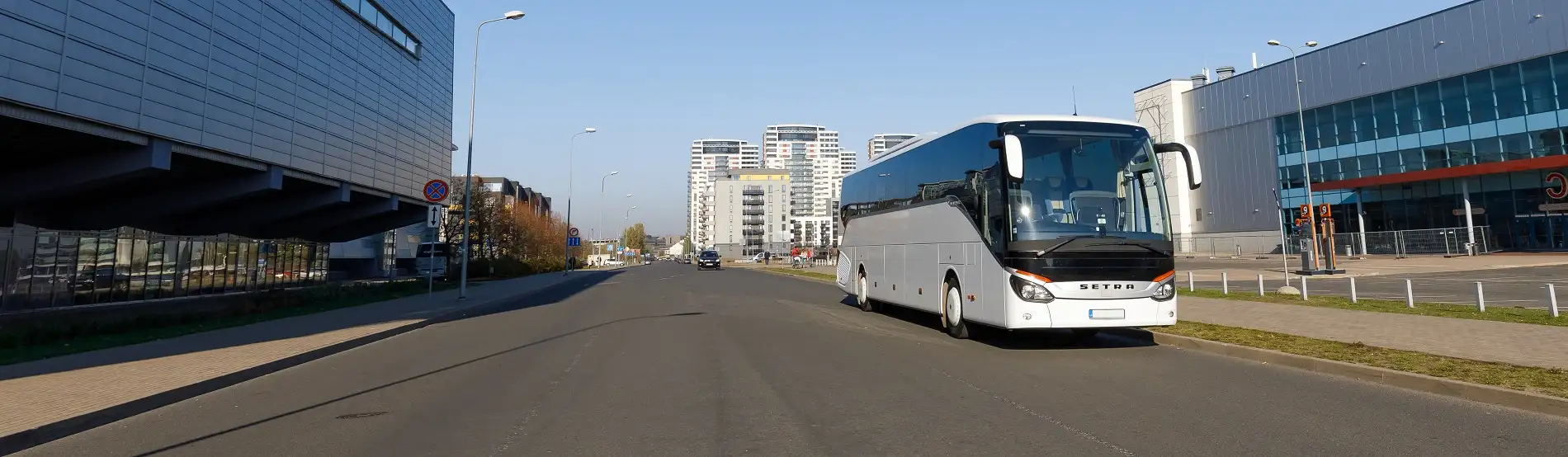
Event and Festival Transportation across Europe: Shuttle Services for Festivals, Exhibitions, Congresses, and Corporate Events

From a festival bus charter running across multiple days to a single congress shuttle, event transport is not a single booking. It is a live operation, which means conditions change and the transport plan has to change with them. Crowds move unpredictably, venues have access restrictions, drivers work within EU hour regulations, and schedules shift the moment the event does.
We plan, coordinate, and manage group transport for events across 20+ European countries. Festivals and concerts, exhibitions and trade fairs, Meetings, Incentives, Conferences, and Exhibitions (MICE) congresses, and corporate events. We select the carriers, monitor the operation, and step in when something changes. The organizer does not need to manage a single vehicle.
BCS handles the transport. The organizer handles the event.
 Excellent
Book Your Service
Get a quote within 30 minutes
Event and Festival Transportation - Complete Guide
Why Event Organizers Choose BCS
BCS has been managing event transportation across Europe since 2012 and has been recognized with the TripAdvisor Travelers Choice Award 2026. Over that time, we have built direct relationships with vetted carriers in 20+ countries. In Munich, Amsterdam, or Barcelona, we already have established contacts with operators who have delivered under real event conditions.
Working with multiple carrier partners in each city means we are not limited to one fleet or one vehicle type. If the event needs a mix of minibuses and full-size coaches, or executive vehicles alongside standard shuttles, we arrange it across our partner network. Depending on what the event needs, we draw from one to ten different partners in a city. That is not something a single direct booking can offer.
For every event, whether booked directly or through a Destination Management Company (DMC), clients work with a dedicated account manager and a single point of contact throughout the operation.
BCS has provided delegate transport for government-level events, including the G20 summit in Hamburg where we coordinated transport for the Indonesian government delegation. At that level, the transport needs to be managed, not just delivered.
What Makes Event Transport Different: Challenges and How BCS Addresses Them
Event transport planning has consistent failure points. Not because organizers are unprepared, but because even a detailed transport brief rarely anticipates how event conditions on the ground will behave. Venue access, airport exit times, and event charter bus routing all have variables that only become visible in operation. Capacity planning built around ideal conditions is not the same as planning built around real event behavior. After 14+ years of event operations across Europe, we know where the plan will be tested before it happens.
We review venue access specifications before any vehicle is assigned, not after the booking is confirmed. Route timing for coaches is built from operational experience with event schedules, not from navigation apps. And we build buffer time into every airport to venue transfer and exhibition exit schedule, based on what actually happens at events, not what organizers or PCOs expect to happen.
Questions About Event Transport Planning
All answers provided by the BCS Bus operations team based on real operational experience.
Mistakes very often involve an incorrectly selected type of transport, that it cannot drive in somewhere, pull up somewhere. There are restrictions on weight, size, and everything. Next, the incorrect thing is timing, that they often look at movement using Google Maps. That is incorrect. Our time is longer for buses and heavy equipment. Also, they incorrectly plan the exit from the airport, exit from the exhibition, and all that. They think they will quickly reach it, but they don’t take into account the restrictions, that there’s a crowd of people, luggage will be issued later, and all that. These mistakes are made. They create a very narrow time window and shove a lot into it. We try to explain that it won’t work like that. Often clients say: “No, it will all be like that. We already did it like that.” And then they have to pay extra for extra hours and our work.
Who This Service Is For
We organize group transportation for event professionals, MICE planners, and event ground handlers who need the transport operation handled, not left to the organizer to handle when the event is running.
Festival producers and concert organizers need certainty that thousands of attendees reach the venue and return safely, without managing transport themselves.
Exhibition and trade fair organizers need multi-day coordination for exhibitors and visitors across venues with restricted access and city-specific permit requirements.
Congress and conference Professional Conference Organizers (PCOs) need delegate shuttle programs synchronized with session schedules. Groups move between multiple hotels and a central venue throughout the day.
Corporate event teams and travel managers need transport that reflects the standard of their event. That means the right vehicle for each group arriving at the airport and the right level of service for senior attendees, without the team managing a single transfer themselves.
Travel agencies and Destination Management Company (DMC) partners need a reliable ground transport layer that integrates cleanly into their program delivery.
Concert promoters and venue operators need flexible, scalable shuttle operations for audiences at short notice or recurring events.
Event Types BCS Serves: Festivals, Exhibitions, Trade Fairs, Congresses, and Corporate Events
Festivals and Concerts
Festival shuttle operations are built around looping routes between city centers and festival sites, running continuously from first arrivals to last departures. When we coordinated transport for Tomorrowland in Belgium, shuttle loops ran across two weekends with late-night return schedules built around crowd dispersal rather than fixed departure times. The operation has to be designed around that uncertainty from the start, not treated as a variable to resolve once the event starts.
Exhibitions and Trade Fairs
Exhibition transport starts before the doors open, with early access coordination built into the schedule from day one. For multi-day events, exhibition coach hire is planned around badge access windows and venue-specific entry requirements that vary by city.
At Messe München and Messe Frankfurt, knowing which gates and pavilions to use saves significant time on the ground. In Cologne and Dusseldorf, a permit is required to pull up directly at the entrance. In Berlin, the specific gate matters, and parking sometimes needs to be purchased in advance. At RAI Amsterdam, large coaches cannot enter the surrounding streets. Groups need to be redirected to designated drop-off points in advance. In Barcelona, two exhibition halls sit on the same street approximately four to five kilometers apart. Clients regularly confuse the addresses. We coordinate access permits, loading zone timing, and multi-day vehicle scheduling so exhibitors arrive at the right entrance, on time, every day.
Congresses and Conferences
Congress transport for MICE events runs on a tighter schedule than most other event types, from regional industry congresses to government summits such as the G20 in Hamburg, where we coordinated transport for the Indonesian government delegation. Delegates move between multiple hotels and a central venue, with shuttle loops synchronized to session start and end times. A departure that runs five minutes late at the hotel affects every session that follows.
Airport dispersal at the end of a congress is its own challenge. Delegates leave in waves across different terminals, with varying flight times and luggage volumes. We manage the dispersal schedule so the operation runs in sequence rather than all at once.
Corporate Events
Corporate event transport is rarely a single vehicle type. When delegates arrive at an airport in groups of different sizes across different flights, the vehicle matched to each arrival depends on how many people are in that group at that moment. Seven people arriving together do not need to wait for a coach. Thirty-five people arriving together do not need four taxis.
We manage the vehicle mix across all arrivals and distribute delegates to the right hotels based on where each participant is staying. For senior attendees or executive transfers, branded or executive vehicles are available through the carrier network. We handle the full arrival sequence so no delegate is left waiting and no vehicle is sent empty.
Real-World Cases at Scale
Tomorrowland, Belgium
For the Tomorrowland festival in Belgium, we coordinated festival bus hire across two weekends of continuous shuttle operations. The plan going into week one was three coaches. By the time vehicles were approaching Boom, traffic congestion had made that schedule unworkable. Five coaches were deployed instead. In week two, four coaches ran in the morning and four in the evening, eight vehicles operating simultaneously across a multi-route operation. The main operational challenge was the evening collection. Drivers work within strict EU hour limits, and crowds do not leave on a fixed schedule. Both had to be managed together, in real time, across two full weekends.
Maritime Conference, Munich
A maritime conference in Munich brought together more than 300 international participants, arriving in groups of one to five people on separate flights from across the world. The client had combined as many flights as possible to reduce costs. The result was a schedule that could not hold. Some flights were delayed, others arrived early, passport control queues varied, and baggage collection added further unpredictability to every arrival.
At the last moment, we made the decision to send a representative to the airport to coordinate on-site. The client had declined to send their own. Our coordinator managed arrivals across different terminals, guided participants who were lost, and matched each group to the right vehicle as they emerged. Seven people arriving together got a small car. Thirty-five arriving at once got a coach. Each participant was delivered to their own hotel. The conference ran without a single missed transfer. The client did not need to manage a single airport arrival themselves.
We have also provided delegate transport for government-level events, including the G20 summit in Hamburg, transporting the Indonesian government delegation.
Planning Your Event Shuttle Operation
Every event transport plan starts with the same question: what does the operation actually need to look like when the event runs? Requirement mapping, route design, and timeline building against the event schedule are the foundation. Access restrictions, permit requirements, and driver scheduling under EU Regulation 561/2006 all need to be identified before the first vehicle moves. For event bus rental at any scale, early engagement produces better outcomes and more accurate pricing.
All drivers operating within our carrier network hold CPC certification, meeting the professional qualification requirements for passenger transport. Driver hours are recorded via digital tachograph, ensuring compliance with EU working time regulations across every operation. Any overrun in the evening program directly affects the driver’s available start time the following morning. Schedule buffers are not optional. They are a regulatory requirement.
For groups arriving on several flights, standard booking includes 20 minutes of waiting time. Beyond that, additional charges apply. The practical solution depends on the spread of arrivals. If flights land within a manageable window, a single pickup time aligned with the last arrival keeps the operation simple. If arrivals are spread across several hours, splitting into separate transfers is more efficient. In some cases, smaller vehicles handle early-arriving passengers the same day, with the full group moving together on a coach the following morning once everyone has landed.
When a venue has restricted access or no dedicated coach parking, the route is planned around the nearest viable stopping point. If a coach cannot reach the entrance directly, smaller vehicles meet the group at the drop-off point and complete the final leg.
Questions About Planning and Booking Timelines
All answers provided by the BCS Bus operations team based on real operational experience.
Booking timelines depend on the scale of the event. Organized companies typically request nine months to a year ahead and plan at six months. Three to five months is a good lead time for most events. At one to two months out, availability becomes limited, and pricing rises. Partners with the right vehicles are already committed elsewhere, which means working with higher-cost alternatives or compromising on vehicle type.
The earlier the booking, the more options are available and the more accurate the pricing. As a general rule, the closer to the event, the less flexibility there is on timing and pricing. “Clients often request six months ahead, return a month before the event, and wonder why the prices are like this.” Even at the last minute, we have a structural advantage. Working with multiple suppliers across each city means vehicles can be gathered from several operators simultaneously. A single operator booking cannot do that.
On-the-Day Operations and Real-Time Support
While the event runs, conditions on the ground keep moving. Schedules shift, and crowds build at collection points faster than expected; what was working an hour ago may need adjusting. The event shuttle service is managed in real time so the organizer is not left handling transport problems alone.
Questions About On-the-Day Operations
All answers provided by the BCS Bus operations team based on real operational experience.
Our operations desk runs 24/7, accessible by mobile, WhatsApp, and office line. Issues can be reported directly, and a response begins immediately. When something changes during the event, the situation is assessed and resolved at the operations level, and we confirm what can be adjusted in real time.
The process is kept simple. An agreed meeting point is set in advance, the vehicle carries a visible meeting sign, and the driver’s named contact is shared with the group leader before departure. If needed, the driver can share their live GPS location via WhatsApp so the group can find the vehicle directly. For larger operations, an on-site assistant can be arranged on request to help manage the departure and guide passengers to the right vehicle.
This is not theoretical. At the maritime conference in Munich, we deployed a representative to the airport to manage a situation that would otherwise have required the client to intervene. The same applies to group airport transfers, where arrivals are coordinated from the moment the group lands.
European Coverage and Local Expertise
Geographic coverage is not the same as local expertise. Working with us means your event transport will be run by operators who know the market and have built local knowledge from years of operating in it.
In Amsterdam, large coaches cannot enter the city center. Clients regularly request five large buses to the center. We already know this is not possible and redirect to minibus hire or alternative drop-off points before it becomes a problem.
The same applies across Europe’s Limited Traffic Zones, where rules change often and vary by city. Charter access to central Rome depends on paid permits booked in advance, with coaches kept out of the historic core and routed to nearby parking for the Vatican and Colosseum (see our Rome ZTL guide). In Paris, the central ZTL covering the first four arrondissements is restricted around the clock, so coaches enter only with proof of a hotel booking or reservation inside the zone (Paris ZTL guide). In Milan, the Fashion District is now closed to coaches 24/7, with drop-offs redirected to Piazza Castello and other approved points (Milan ZTL update). We track these rules so clients do not have to, and the route is planned around them before travel.
On permits and road closures, the position is straightforward. We cannot file permit applications directly. Those must be submitted by the transport operator or the event organizer. What we can do is advise on where to apply and what is required. Every city, and sometimes every district within a city, has its own rules. Knowing those rules in advance is part of what we bring to the planning process.
For events spanning multiple countries, the Schengen Area simplifies border movement but does not remove the planning requirements. Driver hours, route documentation, and local carrier regulations all vary across borders and need to be built into the transport plan in advance. Across every destination, the client deals with one contact. The complexity of coordinating across national borders stays on our side.
Fleet, Vehicle Mix, and Branding Options
“We don’t use just one fleet, but many fleets. We have many partners. From these needs, we can take from one to ten different partners in a city, depending on who has the necessary type of transport for the necessary services.”
— Maxim, OperationsThrough our carrier network, vehicles range from executive sedans and Mercedes-Benz Sprinter minibuses for smaller groups, to full-size coaches accommodating 55 or more passengers for large shuttle operations. Event minibus rental is available for mid-size groups and city center operations. Premium vehicles include reclining seats, onboard Wi-Fi, USB charging, PA systems, and climate control. The entire network operates Euro 6 compliant vehicles, ensuring access to Low-Emission Zones and Ultra-Low Emission Zones across European cities.
Vehicle branding is available in two forms. Magnetic stickers are the simplest option. They can be applied and removed on the day, and carriers agree to them readily. A full vinyl wrap is a different operation entirely. The vehicle needs to be reserved specifically for the wrapping and removal periods, which takes it out of service for that time. As Pavel from our sales team puts it: “completely different money.” Both options are available on request.
Working with DMCs, Travel Agencies, and Event Planners
For Destination Management Companies, travel agencies, and event planners, transport is one layer within a larger program delivery. The ground logistics need to work cleanly without adding to the coordination burden the team is already carrying.
We act as the corporate event transportation partner that plugs into the program rather than sitting outside it. One contact, consistent service standards, brand-aligned mobility, and a dedicated account manager across every destination. Whether the program runs across one city or several, the transport layer stays the same.
Booking a local operator directly has real limitations. Three come up consistently.
First, when booking direct, the client cannot always know what vehicle types the operator has available, how many vehicles they have, or how close they are to the event location.
Second, language barriers with Spanish, Italian, and French operators are a real operational issue. We have direct manager contacts built over years, which means no translation difficulties and no miscommunication under pressure.
Third, we select the operator against the specific requirements of the booking: passenger count, vehicle type, and timing, rather than working with whoever is available.
For event agencies and DMCs, we are the ground logistics partner that removes transport coordination from the delivery equation entirely.
Sustainability and Environmental Responsibility
Sustainability is increasingly a procurement consideration for event organizers, particularly in Northern and Western Europe where ESG commitments are built into supplier selection criteria.
We coordinate operators that meet Euro 6 emissions standards, ensuring uninterrupted access to Low-Emission Zones and Ultra-Low Emission Zones across European cities. For organizations with active ESG or CSR targets, coordinated group transport offers a tangible reduction in per-person carbon footprint compared to individual taxis or rental cars.
Group transport is one of the most straightforward ways to reduce the environmental impact of event travel. Fewer vehicles on the road, better route efficiency, and lower emissions per passenger are the natural result of moving people together rather than separately.
Plan Your Event Shuttle Service
Every event is different. The transport plan needs to reflect the specific program, the venues, the group size, and the schedule it has to work around. We build each operation around those requirements rather than fitting events into a fixed package.
Whether you are organizing a festival, an exhibition, a congress, or a corporate event, get in touch early. If you are coordinating transport as part of a larger program for a travel agency or DMC, we can build the right plan around your requirements.
Contact the BCS event transportation team to plan your next event. The earlier the conversation starts, the better the outcome.
Contact Us Directly
Call Us 24/7
+31 20 700 88 60Email Us
sales.dept@bcs-bus.comOur Office
Radarweg 29, 1043 NX Amsterdam
Netherlands
European Operations Center
Get Your Free Quote Now
Your data is secure and will never be shared with third parties