Fátima to Lourdes
- Days:
- 8
- Gateways:
- Lisbon in, Toulouse out
- Best months:
- May, September, October
Stops:Lisbon, Fátima, Ávila, Burgos, Loyola, Lourdes, Toulouse
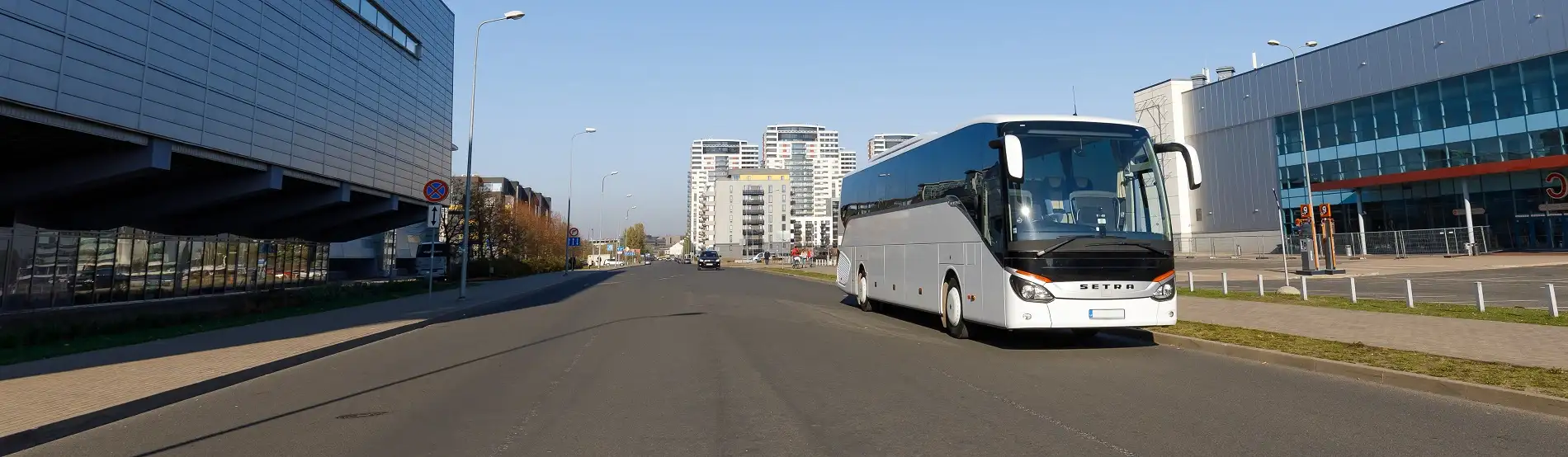
A pilgrimage date is set by the liturgical calendar. A parish planning to be in Fátima on May 13, or in Santiago for the Feast of St. James on July 25, cannot move the trip by a week to suit the transport. The group transport still has to be arranged in a country the pilgrimage organizer may never have worked in.
From the first request to the last transfer, BCS Bus organizes and manages the ground transport for church and faith groups.
BCS Bus does not sell pilgrimages and is not a tour operator. That boundary is a licensing limit under the Package Travel Directive. The program belongs to the organizer. For pilgrimage coach hire in Europe, the contract with BCS Bus is transport only, at a fixed coach price agreed before the organizer confirms.
See the routes our groups travel most often

 Excellent
Get a quote within 30 minutes
Each of the six routes below starts and ends at a gateway airport with connections to the United States. On these pilgrimage bus charter routes, the coach meets the group at the arrival airport and leaves it at the departure airport at the end of the multi-day itinerary. Five are one-way routes and one is a round trip. Three of the six are best in spring and early fall, the shoulder season. These are the routes church and pilgrimage groups travel most often with BCS Bus, and the notes below come from BCS Bus trips.
Stops:Lisbon, Fátima, Ávila, Burgos, Loyola, Lourdes, Toulouse
Stops:Bari, San Giovanni Rotondo, Lanciano, Loreto, Assisi, Rome
Stops:Warsaw, Niepokalanów, Częstochowa, Wadowice, Kraków with Łagiewniki and Auschwitz
Stops:Santiago de Compostela, Porto, Fátima, Lisbon
Stops:Dubrovnik, Medjugorje, Dubrovnik
Stops:Berlin, Wittenberg, Erfurt, Eisenach, Worms, Strasbourg, Zurich, Geneva
Fátima to Lourdes. From May to October, crowds at the shrine of Our Lady of Fátima peak on the 12th and 13th of every month, the vigil and anniversary of the 1917 apparitions at Cova da Iria. On those dates, the coach drops the group off before the evening candlelight procession and collects it afterwards. The route runs north through St. Teresa's Ávila, then Burgos and St. Ignatius's Loyola, to Lourdes, where Our Lady of Lourdes appeared to St. Bernadette in 1858, before the group flies home from Toulouse.
Padre Pio, Loreto and Assisi. Groups land in Bari for San Giovanni Rotondo, where Padre Pio lived and is buried, then travel north through Lanciano and Loreto to Assisi before ending in Rome. Coach access is tightly limited in Assisi's old town and in Rome's restricted traffic zone, and the drop-off point in each is fixed in advance. October, with the Feast of St. Francis on the 4th, is one of the best months for the route.
Divine Mercy and St. John Paul II. From Warsaw, the route runs to Niepokalanów, the friary founded by St. Maximilian Kolbe, then to the icon at Jasna Góra in Częstochowa and to Wadowice, where John Paul II was born. Łagiewniki and Auschwitz-Birkenau are visited from Kraków, with large luggage left on the coach. Entry to Auschwitz is by reserved personal entry card only, with a museum guide for every group, and the coach timings are built around those bookings.
Camino and Fátima. The route begins at the shrine of St. James in Santiago de Compostela, where the Camino de Santiago ends, and runs south through Porto to Fátima and Lisbon. Santiago's old town is a restricted-access zone of narrow streets, so the group steps off at its edge while the suitcases are driven to the hotel. The next Jacobean Holy Year is 2027, when the Feast of St. James on July 25 falls on a Sunday.
Medjugorje from Dubrovnik. With no airport in Medjugorje, the group relies on the coach for the whole stay, from the first transfer to the last. The coach runs the round trip from Dubrovnik across the border into Bosnia and Herzegovina.
Luther, Zwingli and Calvin. This route serves Protestant congregations, seminaries and church groups. It runs from Berlin to Wittenberg, where Martin Luther began the Reformation, through Erfurt and Eisenach to Worms, then on to Strasbourg, to Zurich for Huldrych Zwingli and to Geneva for John Calvin.
Catholic parishes and dioceses travel with BCS Bus, and so do Protestant congregations and seminaries. BCS Bus has also moved Orthodox Jewish groups. Each plans on its own calendar: a diocesan pilgrimage often returns on the same dates every year, while a seminary books around the academic year.
Before departure, religious group transportation is planned with a group leader in a parish or a pilgrimage director in a diocese. Faith-based organizations contract the transport separately from their own programs. During the trip, BCS Bus stays in touch with the group's tour leader.
One or two trips a year, paid for by the people traveling. The organizer is usually a volunteer and needs one number they can divide by the number of travelers.
Annual programs planned six to eleven months ahead, sometimes longer, with the same dates coming back year after year.
Groups that run their own programs and contract the transport separately, often several departures across one season.
Reformation heritage routes through Germany and Switzerland, booked around the academic and summer calendar.
Heritage programs in Central Europe, planned around a fixed calendar.
A coach bus in Italy for pilgrimage groups cannot drive into Rome's historic center at will: the restricted traffic zone (ZTL) limits where it can stop, and entry needs a permit. Coach access is checked for every hotel and stop at the request stage. The BCS Bus sales team confirms that a coach can reach each one before the organizer commits, so nobody is told after booking that the coach cannot get there.
Before the quote is issued, the sales team maps the route and marks where a coach physically cannot pass and where a pedestrian zone adds to the walk. The drop-off point and pick-up point are agreed at the same stage. Anything unclear is checked again with the carrier.
For a coach bus in Italy for pilgrimage groups, Rome is where most of this work happens, with a drop-off planned at St. Peter's and at basilicas such as Santa Maria Maggiore and St. John Lateran. Barcelona and the Alpine villages of Switzerland and Italy come up often too. Timed entry needs the same care: at the Auschwitz-Birkenau Memorial, reserved entry cards and the museum guide fix the hour the coach has to arrive.
The ZTL permit, like any coach permit for a restricted zone, is obtained by the local carrier. The carrier holds the license and the documents proving the booking and the group, and the permit is issued on that basis at the transport directorate or the municipality.
Answers provided by Maxim, COO at BCS Bus, based on real operational experience.
At the Vatican the coach can drop the group off and pick the group up within a radius of 10 to 15 minutes on foot. The map of the zones is public, but inside it we have our own points marked, the ones we use regularly and offer to groups.
The carrier arranges it. Very often it is paid on site. It looks like this: tomorrow the group goes to Rome, the driver says what time we arrive and that he needs a permit. The carrier's office buys the permit and gives it to the driver. It has to be the carrier's office, because in certain cases the carrier has to provide documents that we do not have.
The main one is Rome, because into some centers nothing except a seven-seater can enter. For us that is 80% Rome. Now there are also restrictions in Barcelona when it is far to walk, and sometimes Madrid. Porto and Lisbon simply because the streets are very small. If people cannot walk, we order seven-seater shuttle vans.
Everything depends on the city and what the rules are. Sometimes the rules change during the year, a new zone appears, something else. We look at everything in real time. Even if you can drive there and they drove there a week ago, the following week there can be an event, a rally or a parade, and the zones are closed again. In Europe this happens very often.
It is a separate line on the invoice. It depends how it is agreed. If it is agreed in advance, then the price is written as all-inclusive. But if we find out when the tour has already started, or a couple of days before the start, then it is billed as an extra.
A parish advertises a trip for 53, and 31 people sign up. Church group bus rental starts from the final passenger count. The seat count follows the group, and the coach changes to fit the 31.
Every coach has a PA system with a microphone. A group uses it to pray together, and a guide uses it on the move. Each coach assigned meets the Euro 6 standard, which keeps it legal inside city emission zones.
Luggage changes the arithmetic. Where a group flies in from overseas and each traveler brings a large checked suitcase of up to 32 kg, the coach is planned with about ten seats more than the headcount: 45 travelers on a 55-seater. A group traveling light is seated to its own number.

Answers provided by the BCS Bus operations and sales team based on real operational experience.
For 53 people we plan a 55-seater. If the final number comes under 50, 31 for example, we take a 49-seater, and usually it is 5 to 10% cheaper. With four weeks we can change this in most cases. There are 35-seaters, but there are few of them, and for long trips carriers usually don't give them.
It depends on the season and on the type of bus. From 50 to 55 seats is not critical. Double-deckers or non-standard buses, better in advance. In season it can be changed one to three days before.
On a charter bus for US church groups, the pace of the day is agreed with the tour leader. Only the tour leader on site can judge the condition of the group and the weather. Comfort stops and boarding times follow that judgment. Rest stops on the highway are made at the service areas coaches use.
Luggage is settled before booking. By email and phone, the sales manager collects the number of checked suitcases and pieces of hand luggage, with approximate weights. The luggage volume and the weight limit are checked against those figures before the coach is chosen. A religious group on a 10- to 12-day program travels with a lot of luggage, whatever its denomination. Suitcases on a charter bus for US church groups arrive packed to US airline allowances.
Charter bus luggage rules: US vs EU guide
Answers provided by the BCS Bus operations and sales team based on real operational experience.
The bus stops every hour and a half to two hours anyway. The driver has mandatory breaks, and on the motorway there are special areas where all buses stop, so people can use the restroom there. If someone needs a stop earlier, the driver will stop. Usually there is no problem with this.
If the group needs a toilet on board, we need to know when we book. On some buses that space is used for the luggage compartment instead. And if there is a toilet, it has to be prepared, you need to fill the fluids and the chemicals, and that takes time. The earlier we know, the better, so the right bus is assigned.
This is a general problem and it comes from different rules. In the US the airlines allow suitcases up to 32 kg and they look mostly at the dimensions. In Europe it is 23 kg checked and 10 kg cabin. On a coach the limit is about 25 kg per suitcase, and the hold is 9.6 to 14.3 cubic meters, which by volume is around 4 tonnes, already a large part of what the vehicle is allowed to carry. So a group flying in from outside Europe packs by the rules they know, and the suitcases are bigger than the hold was planned for. That is why we ask for the number of bags, approximate sizes and weights when we quote, and not on the day. In Europe they also check the weight now, and an overloaded bus can be stopped. If the volume does not fit, we solve it before departure: a bigger vehicle, a second one, or a van or trailer for the luggage.
What surprises them is that in many places in the old towns it is impossible to drive up and you have to walk. In America the roads are wider and you can drive up everywhere. In all of old Europe the streets are very narrow.
Yes, we do that. The driver takes all their luggage at 8 in the morning, drives ahead, and waits at the hotel until the evening. He also has to stay in touch, because if someone feels unwell along the way, or gets very tired, he needs to pick them up. The distances are not big for a bus, they walk about 10 km a day, so the bus gets there much faster. In price it does not really differ from a standard day.
A pilgrimage coach service with driver runs under the EU rules on driving and rest time in Regulation (EC) 561/2006, with driver hours recorded on the tachograph. When the rules require a change of driver, it is planned with the carrier, and a relief driver arrives by plane or other transport to take over.
North American groups booking a pilgrimage coach service with driver expect more conversation from the driver, on the tour and off it. BCS Bus assigns an English-speaking driver who has already worked in the region and knows the access points and the approach to each stop. The group's own guide leads the visit. In Italy and several other countries, guiding is a regulated profession, and the driver does not take that role.
The driver's meals on the road are lunch and dinner. Breakfast is taken at the hotel, so the driver does not lose time before the first departure.

Answers provided by Maxim, COO at BCS Bus, based on real operational experience.
The driver cannot work more than the law allows, so on a long program we change the driver. We look at it together with the carrier and change him a day earlier or a day later, depending on the route. The replacement comes by plane, by bus, or drives his own car if the carrier's base is nearby.
We take a driver who worked in that region before and knows how to approach the places, and who speaks English.
A parish organizer collects the cost of the trip from each traveler and needs one fixed coach price to divide among the travelers. A lower quote with open costs attached cannot be split that way.
Pilgrimage coach rental cost at BCS Bus is set as a per-vehicle quote. It covers the coach, the driver, fuel, road tolls and an agreed number of service hours per day within an agreed kilometer allowance. Parking, tunnels, city entrance permits and the driver's meals and accommodation sit outside it. Each of these is listed as a separate line item, visible to the organizer ahead of the trip. The quote is fixed before anything is signed.
Answers provided by Maxim, COO at BCS Bus, based on real operational experience.
A service hour is from the moment the driver puts in the chip and starts his work, until the moment the driver stops and puts it on pause.
We look at whether it is possible to do on that day, at that moment. If it is not possible to do, we say we cannot do this. If it is possible to do, we say the driver costs this much, we need to go like this and like that. We discuss and suggest options.
The client books it. Sometimes we take it on, about 15 to 20% ask us to book, because then we choose a hotel that is closer and has parking.
Planning religious group coach transportation starts when the organizer sends the route. Before any price is given, BCS Bus checks that a coach can reach every hotel and stop and that the itinerary fits driving and rest rules. Once the contract is signed, the confirmed dates do not move. The usual lead time for religious group coach transportation is six to eleven months, and the more complex the program, the earlier it is booked.
Every coach is insured and operates under national and European licenses. Certificates go to the organizer the same day they are asked for.
Answers provided by the BCS Bus operations and sales team based on real operational experience.
Mostly they come in advance, because the parish plans the budget, how much to collect, and they still have flights and tickets and everything else. Mostly these groups are organized and plan six months ahead or more. The more complex the program, the earlier it happens. We have had requests two years ahead, but that is a very rare case, and on average it is six to eleven months. We can also organize it in a couple of months. It also happens that a group booked with another supplier, something failed there, and they come to us two or three days before the trip.
We don't have that. We have an agreement and a contract. If a contract is signed, it will not be moved anywhere for any money.
All our buses are insured and have state and European licenses. Without this package of documents we don't transport any group. If a client asks for the certificates, we send them the same day.
Once a program grows, a single coordinator in the BCS Bus office takes it over completely. That person is the point of contact for tour leaders and carriers from then on.
The coach for each route comes from a network of vetted carriers that BCS Bus works with under long-term partner agreements. Each is a licensed local operator, and in cities with restricted zones that license is what a European coach company for faith groups relies on.
When plans change mid-trip, the dispatcher checks the driver's remaining hours with the carrier before a new time is agreed. In most cases, the response time is 30 minutes or less.
When an order grows, one person in the office takes it over completely and deals with the tour leaders and the carriers.
The coach is selected to fit the route from carriers BCS Bus works with under long-term agreements.
Entry permits are issued to the licensed local carrier on the strength of the booking documents, which is why that carrier obtains them.
Changes during a trip, including overnight, are handled within half an hour in most cases.
Answers provided by the BCS Bus operations and sales team based on real operational experience.
We are not a tour operator, we organize the transportation service. They usually don't ask, because they have looked at the website. We handle the transport part only, not meals, not tickets, not guides.
There were moments when the departure time was changed five hours before. We contacted the drivers, checked what their hours allowed, and coordinated it. Clients could call at midnight and ask for a bus at 7:30. In most cases we react within 30 minutes.
Groups that come to BCS Bus for faith group bus hire often describe the same problems with a previous supplier. A price was agreed, and then hidden extras and undisclosed surcharges appeared on the invoice. The coach was in poor technical condition or arrived late for the pick-up. In some cases, the vehicle never showed up at all.
Other problems involved the driver. One spoke no English and could not communicate with the group. Another had not studied the route.
Luggage came up as well. Nobody had checked the volume before departure, so the suitcases did not fit in the hold.
Several of these problems start at the quote stage, before any coach is assigned. That is where BCS Bus runs its checks for faith group bus hire: route access, driving hours, luggage and the full list of what is billed separately.
Tell us the route and the dates, and we build the charter around them. The sales team needs five details to price a multi-day program: departure date and time, return date and time, number of travelers, the itinerary and the luggage. The fixed coach price comes back with every separately billed item listed.
12486 SW 54th Street
Miramar, FL 33027, USA
Your data is secure and will never be shared with third parties